You open your phone three times a day to log what you ate, and by day four you've already forgotten. That's the cycle most calorie trackers create — they demand effort, and when life gets busy, the logs disappear. EtinAI takes a different approach. Instead of making you the data entry clerk, it acts as a conversational partner that remembers what you ate and helps you think about your next meal.
I've been testing it for a couple of weeks, and here's what actually surprised me: it doesn't feel like logging. It feels like talking to someone who cares about what you eat, without being judgmental.
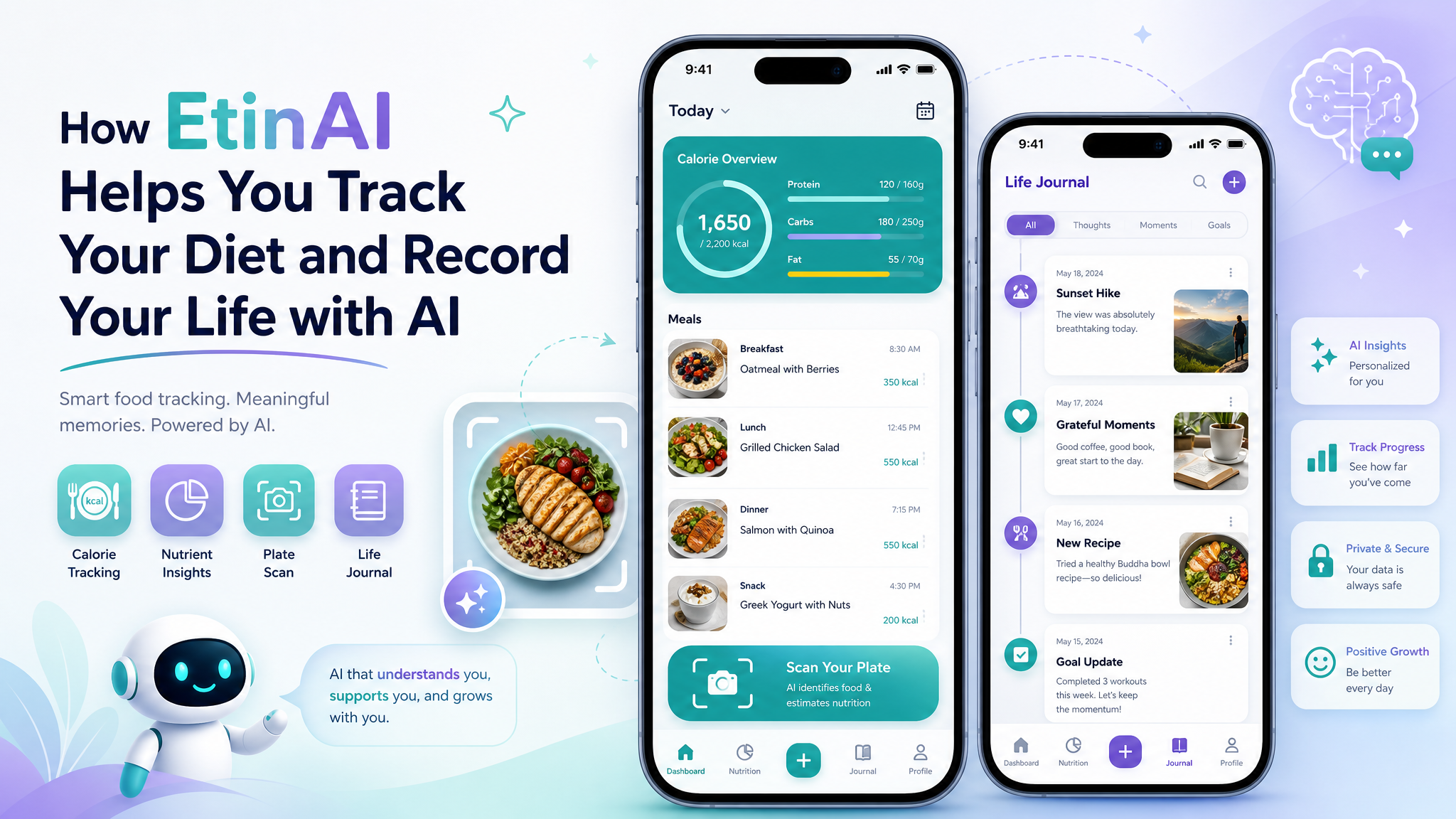
How logging works in practice
The core interaction is simple. You type or speak something like "I had a bowl of pho for lunch" and EtinAI breaks it down — broth, noodles, beef, basil, lime — and gives you a calorie estimate plus macronutrient breakdown. It's not perfect, of course. If you order a complex dish with an unknown sauce, the AI guesses based on common recipes. I tested it with a homemade stir-fry that had peanut sauce. It estimated around 550 calories, which felt reasonable, but the exact number depends on how much oil you used. The point is, it's close enough to be useful for daily awareness, not clinical precision.
Where EtinAI shines is the follow-up. After logging, it might suggest: "That pho has decent protein but could use more vegetables for fiber. Want a quick suggestion for dinner?" That conversational nudge is what keeps you engaged without feeling like homework.
Recording life beyond the plate
EtinAI isn't just a food diary. It also lets you log mood, exercise, sleep, and even random notes about your day. I started using it as a lightweight journal. For example, after a stressful work call, I logged "feeling anxious, had a chocolate bar." The AI didn't scold me. Instead, it noted the emotional trigger and asked if I wanted ideas for stress management that weren't food-related. That small moment of empathy made me trust the tool more than a plain calorie counter ever could.
The life recording aspect is surprisingly sticky. You can add photos — I snapped a picture of my messy desk during a late-night work session, and EtinAI tagged it as "work environment stress." Over a week, patterns emerged. I could see that my worst eating days correlated with poor sleep and high stress. That's valuable insight that a simple food log wouldn't capture.
Real scenarios: where it works and where it stumbles
Scenario 1: The busy professional. A friend of mine, a project manager, tried EtinAI for a week. She eats out constantly — salads, sandwiches, Thai takeout. She said the conversational logging was faster than opening a calorie database app. She just said "I had a grilled chicken Caesar wrap" and got an estimate in seconds. Her main complaint: the AI sometimes misidentified the size. A "large" wrap was estimated as a medium, so she had to adjust portions manually. Not a dealbreaker, but worth noting if you're strict about numbers.
Scenario 2: The emotional eater. I fall into this category. I've used other apps that just record calories and move on. EtinAI's ability to link mood and food made me more conscious. When I logged "boredom snack — chips," the AI gently asked, "Would you like to explore alternative activities when boredom strikes?" That kind of reflective prompt is rare in health tools. It felt less like a lecture and more like a coach.
Scenario 3: The fitness tracker user. If you already have an Apple Watch or Garmin, EtinAI doesn't automatically sync. That's a limitation. You have to manually enter exercise. The AI can estimate calorie burn based on your description ("45-minute run, moderate pace"), but it's not as seamless as an integrated ecosystem. If you rely heavily on auto-sync data, this might frustrate you.
Tradeoffs you should know before committing
EtinAI is not a replacement for medical advice or a registered dietitian. The calorie estimates are based on general nutrition databases and AI inference, not lab analysis. If you have specific health conditions requiring precise macro targets, you should verify with a professional. Also, the app's strength is conversation, not data visualization. Its charts and graphs are basic — you won't get the detailed trend lines you see in MyFitnessPal or Cronometer. For people who love data deep-dives, EtinAI feels light.
Another tradeoff: the AI's suggestions can sometimes feel generic. After three days of similar meals, it started recommending the same "add more greens" tip. It learns over time, but initially it's more scripted than I'd like. The team is clearly iterating, so this may improve.
Who should try EtinAI
If you've tried logging apps before and quit because they felt like work, try this. The conversational interface lowers the barrier significantly. If you want a tool that also helps you reflect on your life — mood, stress, patterns — and not just count calories, EtinAI is worth a download. But if you're a hardcore macro tracker who needs precision and auto-sync, you might find it lacking.
At the end of the day, EtinAI helps you track your diet and record your life with AI in a way that prioritizes consistency over perfection. And for most people, consistency is what moves the needle.
Comments
Leave a Comment